
After you land, the season has flipped
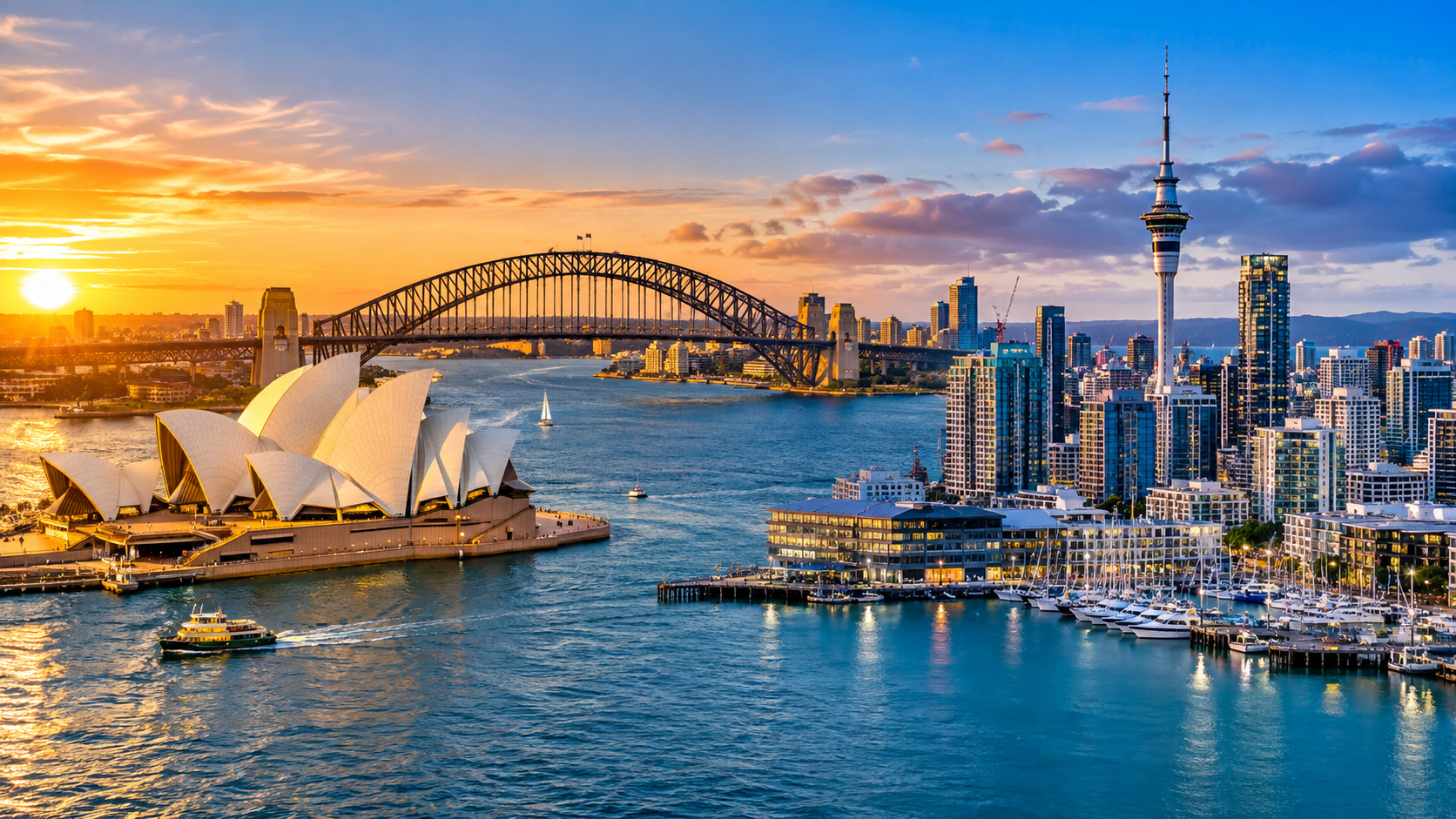
Leave the United States at the end of November and you step off the plane into early summer. In Australia and New Zealand, December is long light, warm afternoons, and a sun that is stronger than it looks. The two countries sit a short flight apart across the Tasman Sea, and they do not feel like variations of the same place. Sydney is a harbour city that knows it is beautiful. The North Island of New Zealand is volcanic, wetter, and wilder at the edges.
A few practical things are worth knowing before the sightseeing starts. Traffic keeps to the left. Australia uses the Australian dollar and New Zealand the New Zealand dollar, so you change money when you cross. Both countries use the same Type I plug, so one adapter covers the trip. Confirm an Australian visitor visa or ETA, and New Zealand’s NZeTA, before you fly. Pack a hat, sunscreen, a light layer for wind, walking shoes, and swimwear. The days are warm. The UV is not gentle.
Sydney, once the harbour comes into view
Most people meet Sydney at the water. The Opera House is the shape everyone recognizes, and a guided walk through it is the right first hour: the shells from the outside, then the rooms, the history, and the reason the building still feels improbable. The Harbour Bridge is the other half of that skyline. A climb up the arch is there if you want the view from above. Even from the promenade, the bridge and the Opera House together explain the city in one glance.
The afternoon belongs to Bondi. Golden sand, surfers on the swells, and cafés along the beachfront. If your legs are willing, the walk from Bondi toward Coogee is the best free introduction to this coast: cliffs, ocean pools, and one headland after another. In the evening, a dinner cruise from Darling Harbour puts the same landmarks back in front of you, this time lit, as the boat moves past the bridge and the Opera House.
Darling Harbour is also where Sydney lets you see the country without leaving the city. At SEA LIFE, glass tunnels put sharks and rays overhead. At WILD LIFE Sydney Zoo, kangaroos, koalas, wombats, and crocodiles stand in for the bush you will not have time to cross on this trip. Sydney Tower Eye is the practical stop: from the deck you can place the harbour, the beaches, and the inland ridges before you go looking for them.
A day in the Blue Mountains
The Blue Mountains begin about two hours west of Sydney, and the air changes as soon as the city drops away. This is a UNESCO World Heritage landscape of eucalyptus valleys, and the haze that gives the mountains their name is real. At Echo Point you look straight at the Three Sisters, the three rock pillars that every photograph of this place is trying to capture.
Scenic World is how you get down into that valley and back up without pretending you are on a trek. The railway is the steepest passenger railway in the world. The Skyway crosses the gorge with a glass floor. The cableway gives you the wide view. Afterward, Leura is the right place to stop: a small mountain village, a café, and a slower hour before the drive back to the harbour.
Use the free day in Sydney on foot
One day in Sydney is unscheduled on purpose. The Rocks is the oldest part of the city, all sandstone lanes and a waterfront you can walk without a ticket. The Royal Botanic Garden runs along the harbour toward Mrs Macquarie’s Point, which is the calmest view of the Opera House. Paddington and Surry Hills are for lunch and a wander. If Bondi was too brief the day before, this is when you go back.
Across the Tasman, Auckland
The flight from Sydney to Auckland is about three hours. You leave one harbour and land in another. Auckland calls itself the City of Sails, and from the air the Hauraki Gulf looks like a scatter of green islands.
The Sky Tower is the fastest way to understand the city. It rises 1,076 feet above the streets. From the deck you can pick out Waitematā Harbour, the Harbour Bridge, the volcanic cone of Mount Eden, and Waiheke Island. Dinner up there is easy to add. It is not part of the planned day, so treat it as your own evening.
The free day in Auckland is the local day. Walk the Viaduct, where the boats are bigger than the cafés. Britomart is the place for shops. A ferry to Waiheke is the half-day people remember: vineyards, coast, and a return across the gulf in the late light. Mount Eden is a short climb for the whole city at once. Mission Bay is the beach walk if you would rather stay level.
Rotorua, where the ground is warm
A full day south of Auckland is the North Island in one stretch. The road passes Tirau, where a corrugated-iron sheep and dog stand over the main street, a small joke about a country built on farming. Te Waihou Blue Springs is the opposite mood: water so clear it looks shallow when it is not, filtered underground for decades before it surfaces. The Redwoods at Whakarewarewa were planted as an experiment and stayed. Walking under them feels like a forest that does not belong here and has decided to anyway.
Wai-O-Tapu is the reason the day exists. It sits in the Taupō Volcanic Zone. Lady Knox Geyser erupts on a schedule. The Champagne Pool is orange, green, and steaming, colored by minerals and heat, not by anyone’s design. Rotorua smells of sulphur. That is the place working, not a flaw in the visit.
The west coast does not behave like the city
Auckland’s west coast faces the Tasman Sea, and it is rougher than the harbour you woke up beside. The drive climbs into the Waitākere Ranges and stops at the Arataki Visitor Centre, where the view runs from forest to open water. Karekare Falls sits in the bush, a short walk to a cascade that feels far from a city of a million people. The Mercer Bay Loop is a clifftop walk with the ocean straight below. Piha is the beach at the end of it: black sand, a heavy surf, and Lion Rock standing in the wash. Swim only where the locals swim. This coast is beautiful and it is not tame.
If you would rather not piece this together alone
The route above is the shape of one hosted departure, The Southern Hemisphere Soirée, from Majestic Global Travel Agency. It runs from 30 November to 10 December 2027, with Tilwanda Dofat as host. You fly from the United States, stay at W Sydney on Darling Harbour and at voco Auckland City Centre, and the days in Sydney, the Blue Mountains, Rotorua, and on the west coast are already set. The trip starts from $4,989 per person, sharing a room. Daily breakfast, round-trip flights, transfers, hotels, and the tours on the itinerary are included.
The day-by-day plan, hotels, and what is included are on the Australia and New Zealand group trip page:
Australia & New Zealand group trip
Other hosted departures are on the group trips page: